What is actually in the box
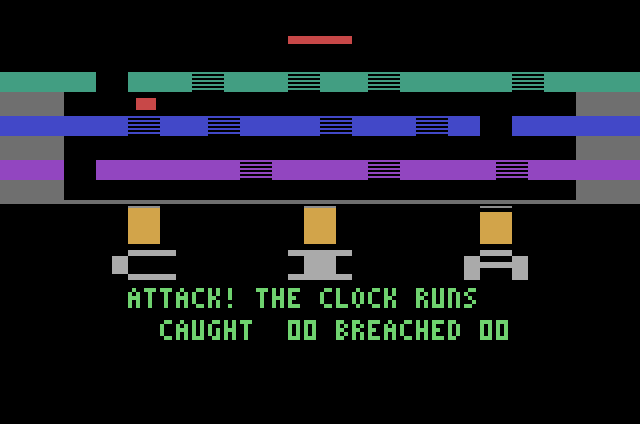
The box shows a fortress under siege. The screen shows this.
In 1981 the painting on the box showed a starfighter and the screen showed four blocks. This page does the same and admits it. Nothing on an Atari 2600 is flash, so all the flash is up top.
Under the painting is a real game. Hands-on Security Lab is a cartridge of security ideas you can play with, and its first room is Defence in Depth. You get three walls full of gaps, and sixteen controls to plug them with: a perimeter fence, CCTV, staff training, a firewall. Then you press fire and an attacker comes for the vault.
You cannot stop them. Leave the open gaps far apart and the attacker has to run along each corridor looking for the next one, while the detection clock burns down. Slow them enough and they are caught.
There is no processor in the cartridge. The console's own 6507, at 1.19 MHz, does every sum.
The numbers on the back of the box
Each board below was attacked 400 times in the reference model the cartridge is checked against. The bar is how often the attacker was caught.
- Nothing plugged1%
- One gap left open in each wall, one under another0%
- Eight controls placed, the six open gaps well apart85%
- The first wall sealed, a straight drop behind it88%
- One gap left open in each wall, as far apart as they go100%
- Every gap plugged, 2,000 attacks99.9%
The second and fifth boards have the same number of gaps open. Where the gaps are decides it.
Plug every gap and the attacker pokes at the controls instead. Each poke has a 9% chance of making the control fail, and twice in those 2,000 attacks one failed in time. A wall with no holes is not a wall with no risk.
Play it here
Press POWER ON, then Space twice to get past the menu and the help page. The arrow keys or W A S D are the stick and Space is fire. With the cursor on the attacker, fire launches the attack. Down moves the cursor to a wall, and left and right choose a gap. Fire on an open gap offers a control, left and right go through the others, and fire places it. Fire on a plugged gap takes the control out. RESET builds new walls and SELECT goes back to the menu. The cartridge has sound. The emulator is Stellerator, by Christian Speckner.
The rooms
One room is built, and only the first of its three levels. Five more are planned and not started. Each comes from Michael Borck's Security Toys, web pages that each break one thing people wrongly believe about security.
-
RetroVerse Studios
Hands-on Security Lab · Room 11 DefenceYou stopped nobody. You made them slow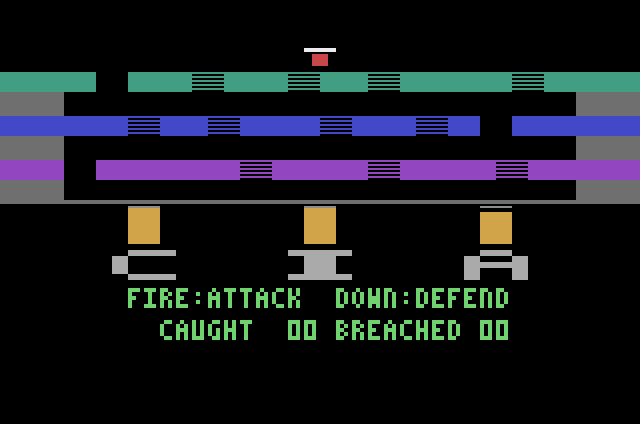 01 · Playable, level 1 of 3
Defence in Depth
Breaks "we bought a firewall, we're fine"Three walls of controls, an attacker and a clock. Level 1 gives you all sixteen controls free. Level 2 adds a budget that buys less than half of them, and level 3 a risk matrix and a report to the board. Those two are designed and not built.
-
RetroVerse Studios
Hands-on Security Lab2 Crack timePlannedLaterCrack Time
Breaks "complexity is what matters"The console brute-forces a hashed password while you watch. Four letters fall in seconds, and each letter more multiplies the wait.
-
RetroVerse Studios
Hands-on Security Lab3 CipherPlannedLaterThe Cipher Bureau
Breaks "hashing is encryption"Encrypt a word with a key and turn it back. Hash it and there is no way back. Change one letter and the whole fingerprint changes.
-
RetroVerse Studios
Hands-on Security Lab4 Rule orderPlannedLaterRule Order
Breaks "a ruleset is a set"Six firewall rules in a list. Reorder them with the stick. Packets come down as dots and stop at the first rule that matches.
-
RetroVerse Studios
Hands-on Security Lab5 DetectionPlannedLaterDetection Dial
Breaks base-rate neglectTwo histograms and a threshold you move. Catch more attackers and you accuse more innocent people.
-
RetroVerse Studios
Hands-on Security Lab6 QueryMaybeLater, if it fitsQuery Builder
Breaks "injection is magic"A database query put together from what you type, a piece at a time. The screen holds 24 characters a line, which is narrow for SQL.
How it was made
- No processor in the cartridge128K of program in 64 slices, switched by the 3E scheme. The console's 6507 does every sum.
- Checked against an answer keyThe same game is written out in Python. A test plays about 10,000 frames on a cycle-exact model of the console and compares every variable on every frame.
- Every frame countedAll 262 lines, frame after frame. Work is cut into pieces that fit the time between pictures.
- One kit, two cartridgesThe menu, the text and the test tools are the Atari lab kit, shared with Hands-on AI Lab.
- The paintingThe fortress at the top is an SVG drawing, and grander than the cartridge on purpose.
- Not yetNobody has run it on a real console. So far it has only run in emulators.